
Visions of Myth and Matter
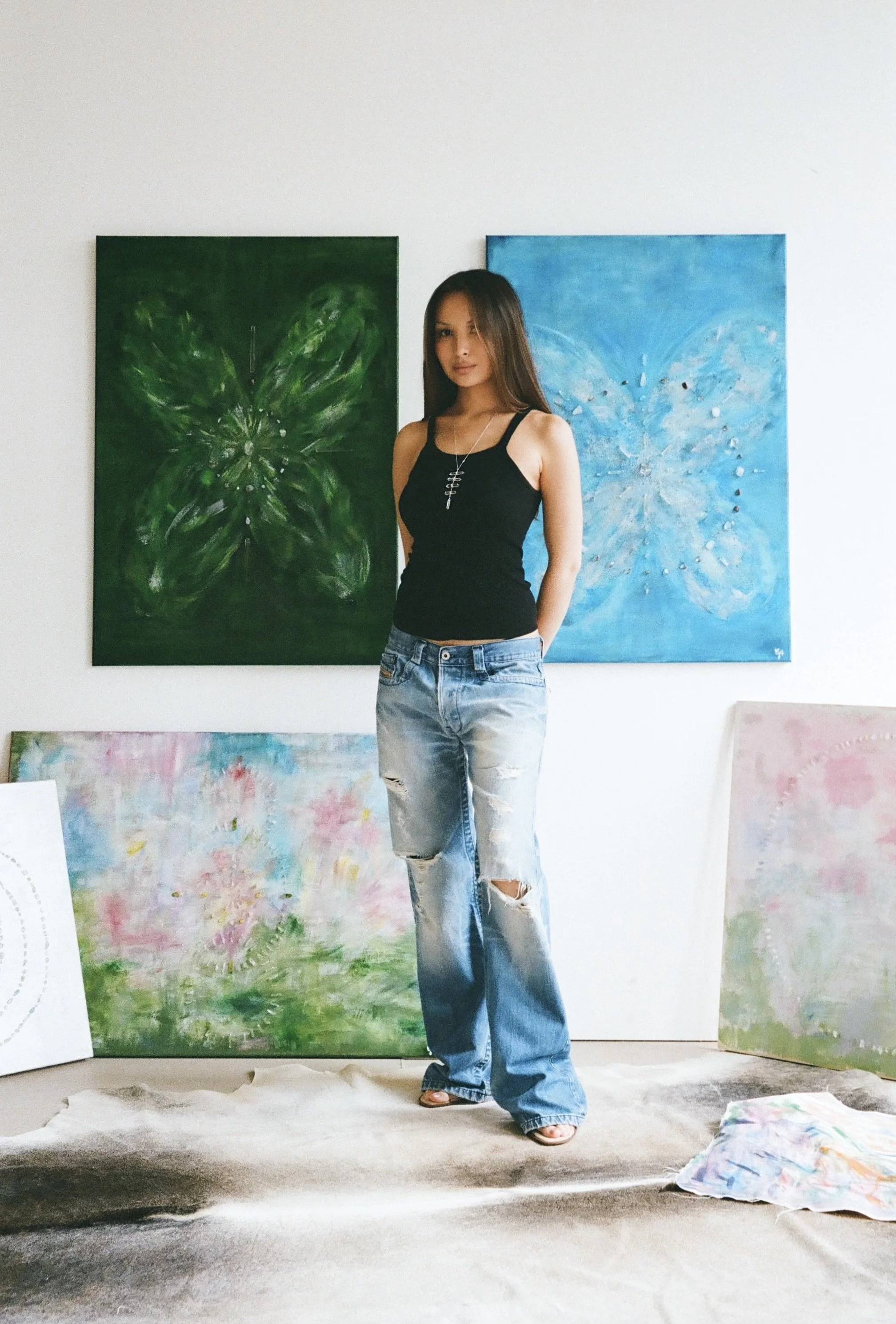
Photography by Amy Beasley
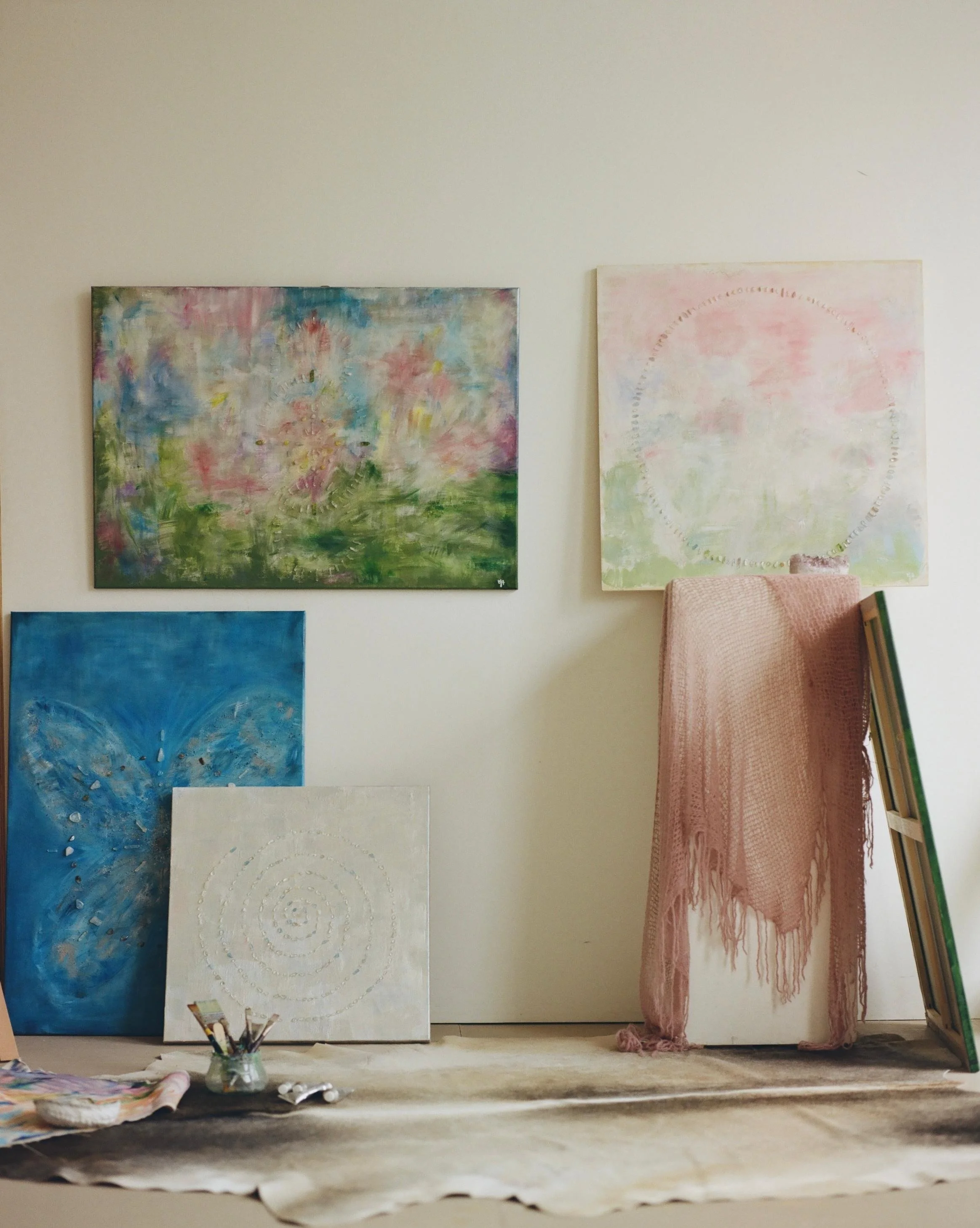
This month, I visited emerging artist Geneva Arystan at her studio in West London. Drawing from her Kazakh heritage, Arystan creates intricate, jewel-like works that bridge the physical and spiritual realms. Crystals serve as her material, medium, and muse, transforming her works into visual gateways. Scroll down for the full interview 🌊🐚🪞
Addy: Geneva, thanks so much for joining me! What is your earliest memory of creating art?
Geneva: Thank you for having me! I think I’ve been creating for as long as I can remember. Poetry and writing came first, visual art followed, and then music. My family always laughs at how I would meditate as a kid, starting around age five. I don’t think I even knew what it was called; I would just sit in silence, breathe, and let my mind go still. They were a bit bewildered by what I was doing, and I later learned the right word and meaning for what, at the time, felt really natural.
During meditation, a lot of ideas would come to me for my poems, and when I learned how to write, I wrote them down in a book that I called my ‘мудрые мысли’ or my ‘wise thoughts.’ I still have that book to this day; I guess it was one of the first of many collections of writings that followed. Later, in high school, I visited Central Saint Martins and knew it was the right place for me.
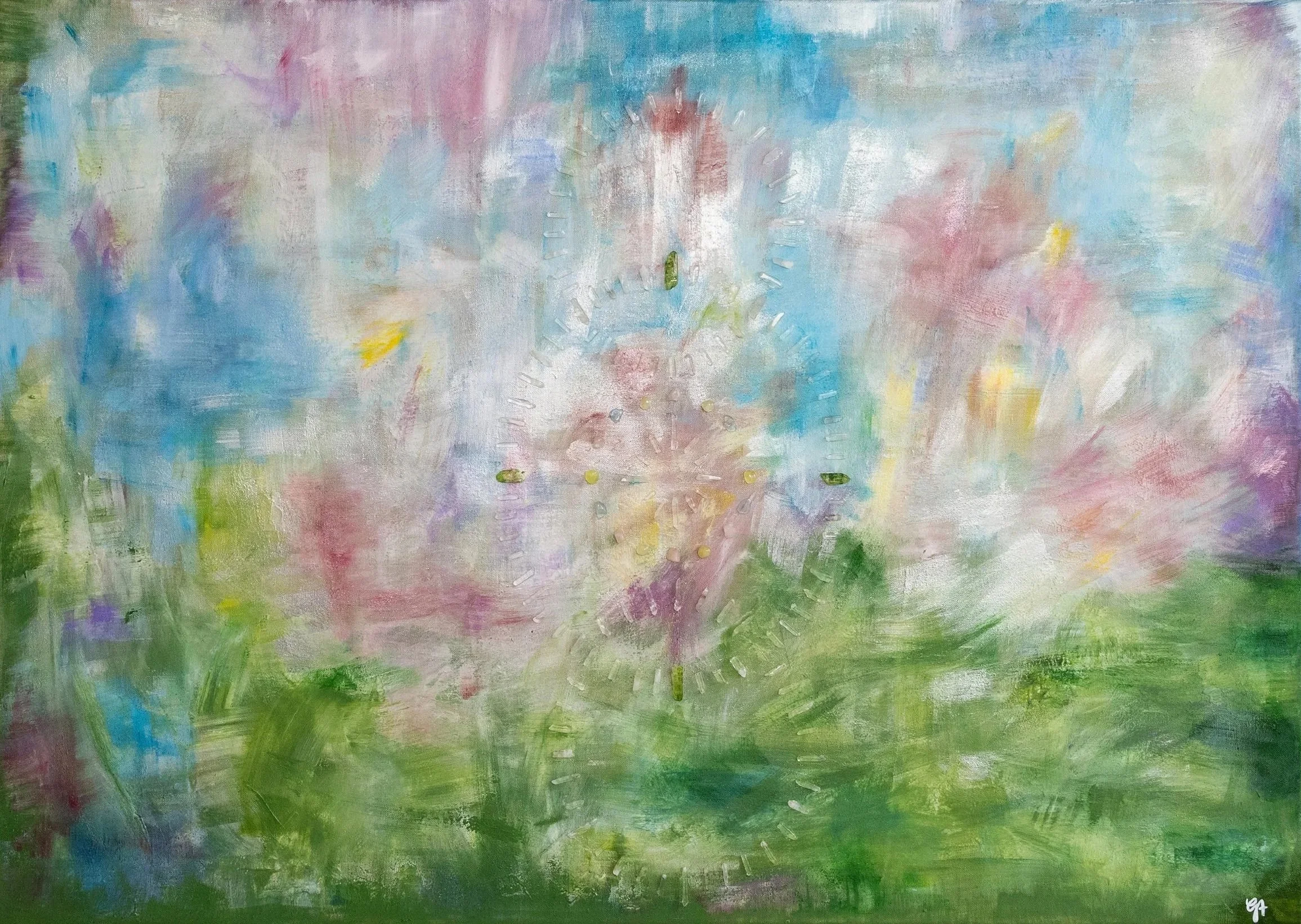
running through an open field by Geneva Arystan
Addy: I love that you meditated as a kid. How does your background in poetry influence your mixed-media works?
Geneva: I think the two have always coincided in my creative work. I go through phases of focusing on different ways of making. The past five years have been defined by poetry, particularly my ever-evolving project, Three People Ago. The work explores intimacy as a transformative force on identity, tracing a journey toward the source of the self beneath these experiences. Having unearthed what that means for me, I now create from that sense of source and explore my relationship with spirit. So, it feels like a very natural trajectory to shift my focus to painting, explore these themes of Tengri spirituality, and connect with my roots in this way.
Addy: Yes, there are clear elements of Tengri spirituality across your work. How has your Kazakh heritage shaped your practice?
Geneva: I think there are two elements that directly inform and permeate my work: the exploration of Tengri, which is all about the spirits of nature, and the physical manifestation of that nature, specifically the crystals and rocks found in my native Almaty. My grandfather was a geologist, so I have many memories of him coming back from week-long expeditions in the Alatau Mountains and bringing back huge geodes and quartz crystals for me as a child; that was kind of my initial introduction to them.
That awareness was later reawakened when I moved to Los Angeles. I’m really curious about the parallels between the shamanism present in tribal Kazakh culture and the New Age mysticism found in California. A lot of my work revolves around trying to find the thread between these two worlds and weaving it into my personal experiences living within them. There are more similarities than you would expect!
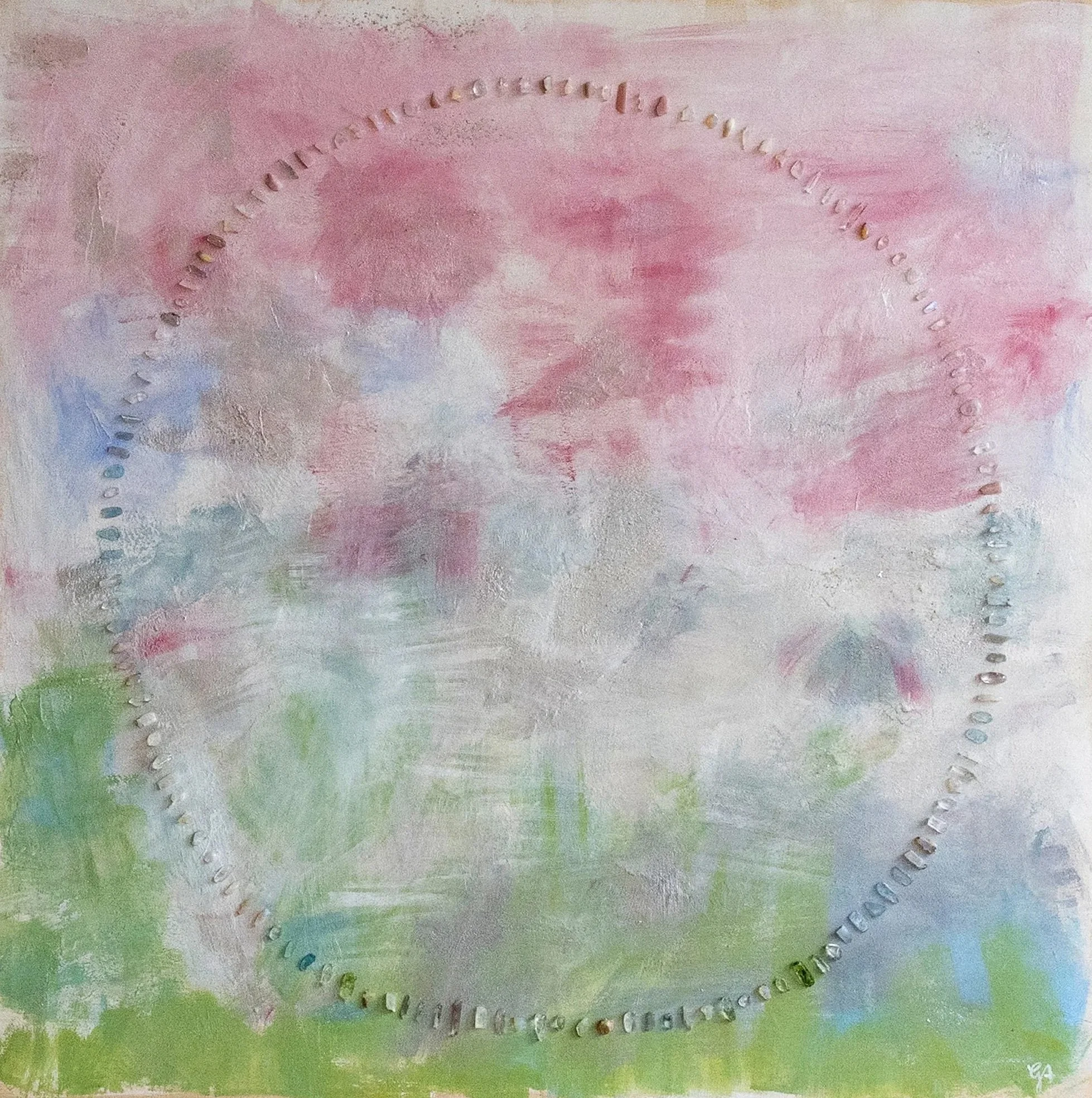
holding hands around a pale fire by Geneva Arystan
Addy: So fascinating, I’ve never considered those parallels! Your work explores the intersection of myth and the metaphysical; how do you personally define that space?
Geneva: I think there’s something really compelling happening in our culture right now, where many spiritual beliefs are beginning to find grounding in scientific research. So much of this ancient knowledge has been under-explored, and scepticism has often led to its premature dismissal. For example, I’m super into learning about fascia right now; scientists had dismissed it forever, but are now discovering it has a piezoelectric charge running through our whole bodies.
The horizontal bands of fascia that cross the spine actually align with the traditional placements of chakra, which is what we’ve already known from Hindu and Buddhist practices. This is fascinating, as it finally confirms the physical basis for the chakra system within the body’s connective tissue. These findings give more evidence for healing practices such as sound healing, Reiki, and meditation. I truly believe that everything is energy; therefore, my work revolves around energetically charging my pieces so that they too can act almost like oberegi (protective objects) for whatever space they inhabit, becoming both the aesthetic and functional embodiment of that idea.
Addy: Totally; we often overlook spiritual practices as a society. Stylistically, there is a tension between your earthy tones and the ethereal feel of the work. What draws you to this specific aesthetic?
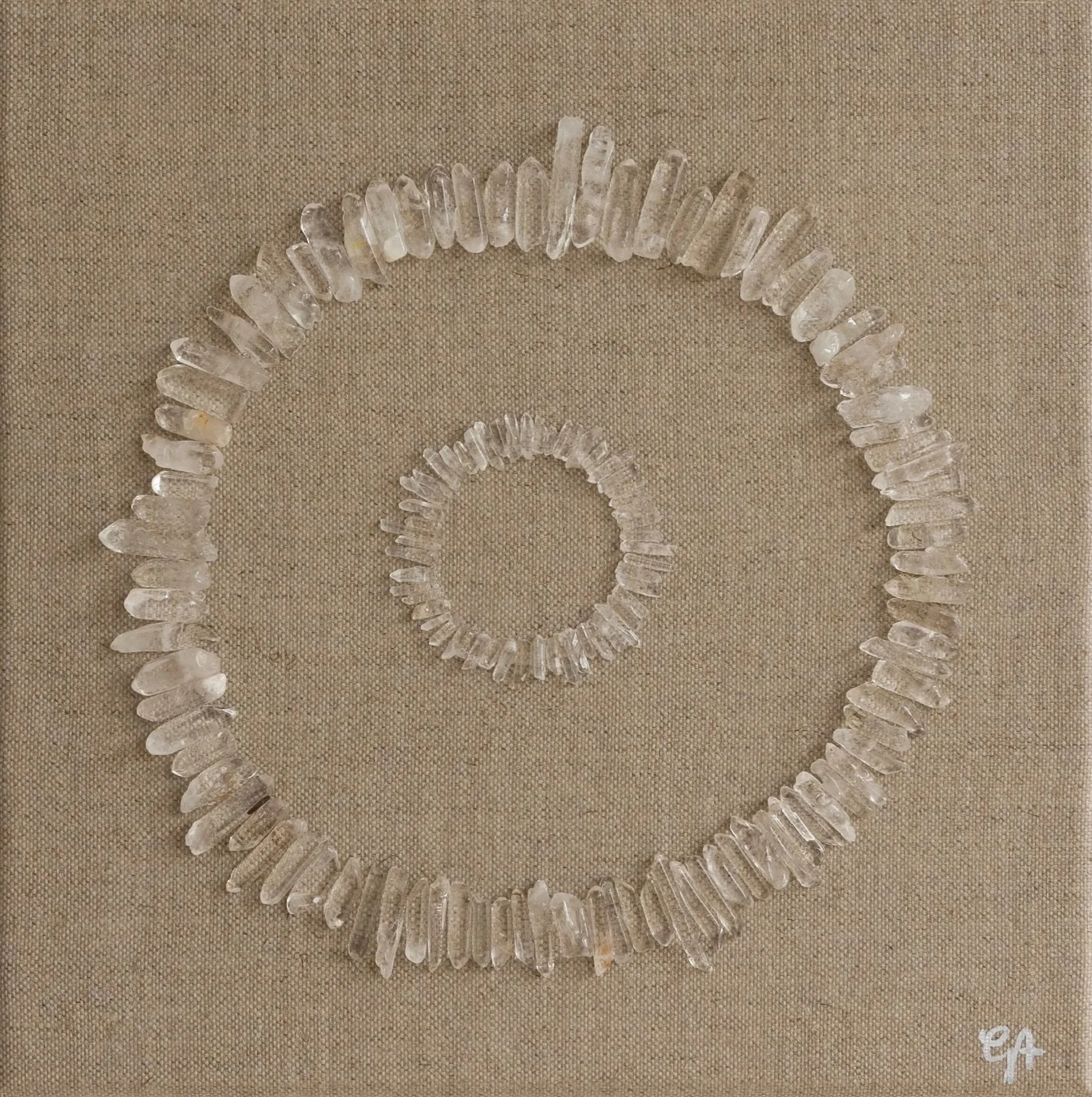
salt circle II by Geneva Arystan
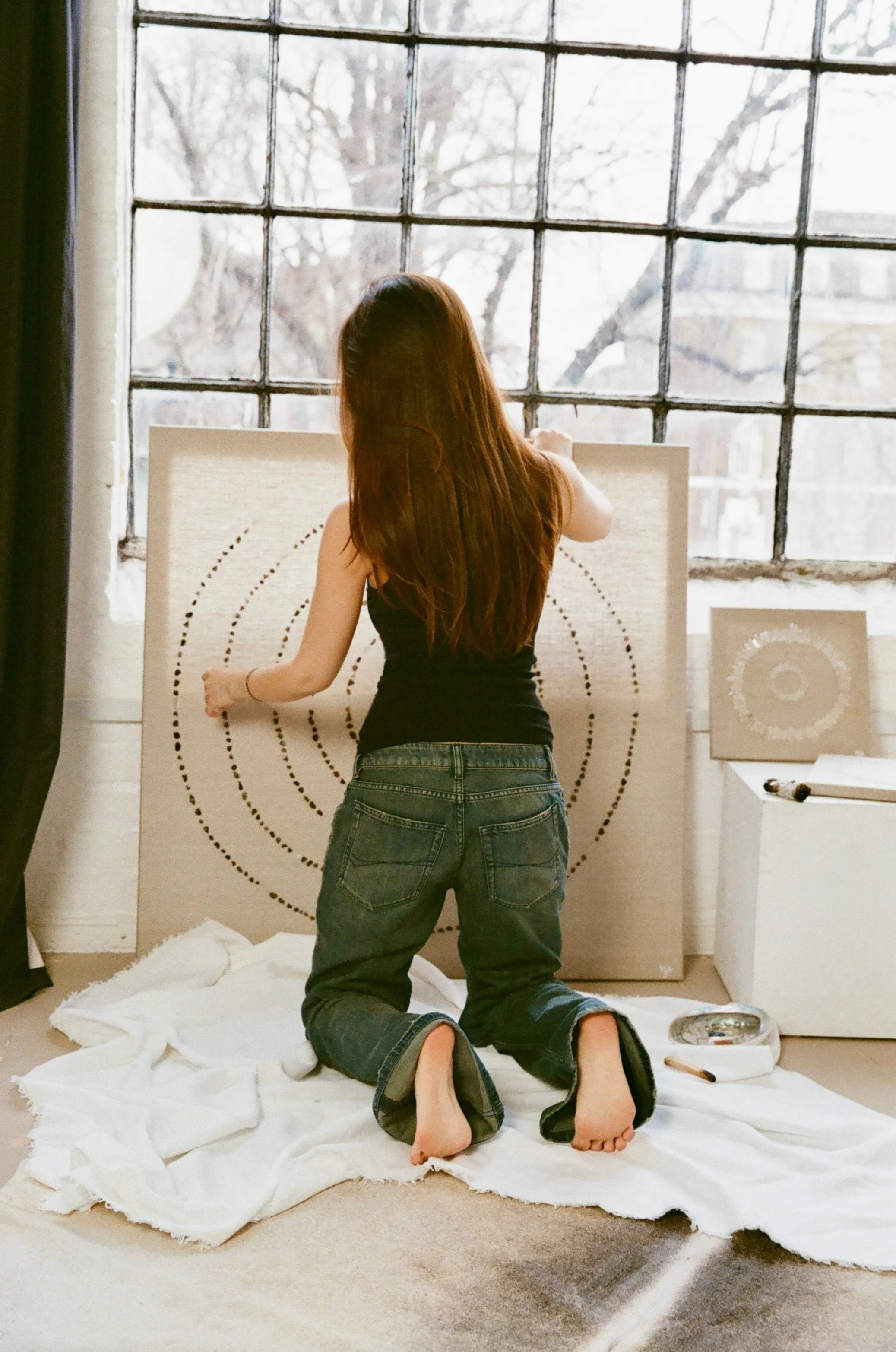
Geneva: I’m always looking for new ways of experimenting with different styles, so some of my pieces are a study of restraint. My salt circle series, for example, intentionally embeds quartz on raw linen, which brings more awareness to the crystals themselves. It plays with the idea of the ritual of sprinkling salt around the perimeter of your house as a means of spiritual protection and as a barrier preventing negative energies from entering.
In contrast, some works are a study of expansion by trying to see how far I can extend my palette and how many different varieties of crystals I can use to supercharge a piece with abundance, even visually so.
Addy: I really like the contrast of restraint and expansion. Can you walk me through your creative process?
Geneva: My practice is very intuitive, so I don’t like to plan out what I’m doing too strictly or force myself to work if I’m not in the right headspace. Everything has to flow. The constant that remains is the preparation of my materials. Every crystal I use is previously cleansed—either by using sage, adraspan (wild rue from Kazakhstan used for smudging practices), or running water. It is then charged by sunlight, moonlight, or selenite.
Once my crystals are prepped, I can get to work. I do a lot of research in my sketchbook, noting down ideas for colour combinations to experiment with later, sketching, and journaling. I enjoy both oil and acrylic; however, right now I’m in a phase where I’m using mostly acrylic. I’m feeling more energetic and therefore impatient at the moment, and I want to follow that momentum rather than restrict it. Painting with acrylic also allows me to use certain mediums to control clarity and texture. This is helpful as I work in layers and need that transparent quality to come through, especially when I’m incorporating crystal pigments into the actual paint.
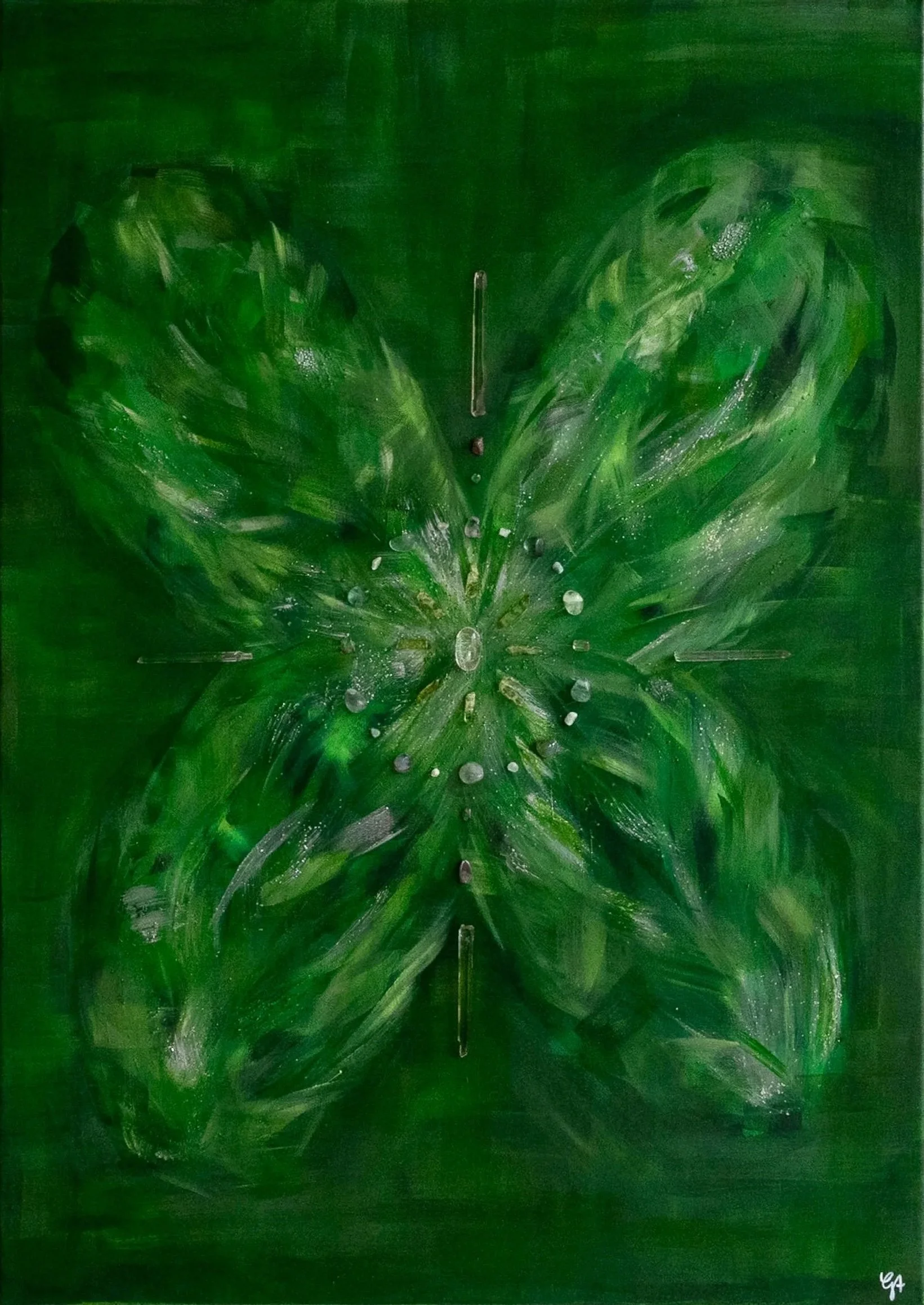
umai by Geneva Arystan
Addy: It’s so interesting to hear how you prepare all the different materials. Crystals are central to your practice; do you view them strictly as materials, or as active participants in the work?
Geneva: They are active agents, as they carry energy and reveal what the work will become. I think they drive the whole direction and act almost as a muse. If I happen to source a rare Australian black opal, then the idea for the painting is born from that. I might be inspired to make use of the opal’s iridescence and try to translate that onto the canvas with paint, finding accompanying materials to echo the way the light works. The materials guide and inspire the work more than anything else.
Addy: Yes, it’s evident in your work that materiality is such a core component. As a mostly self-taught artist, how has your relationship with your materials changed or evolved since you first began?
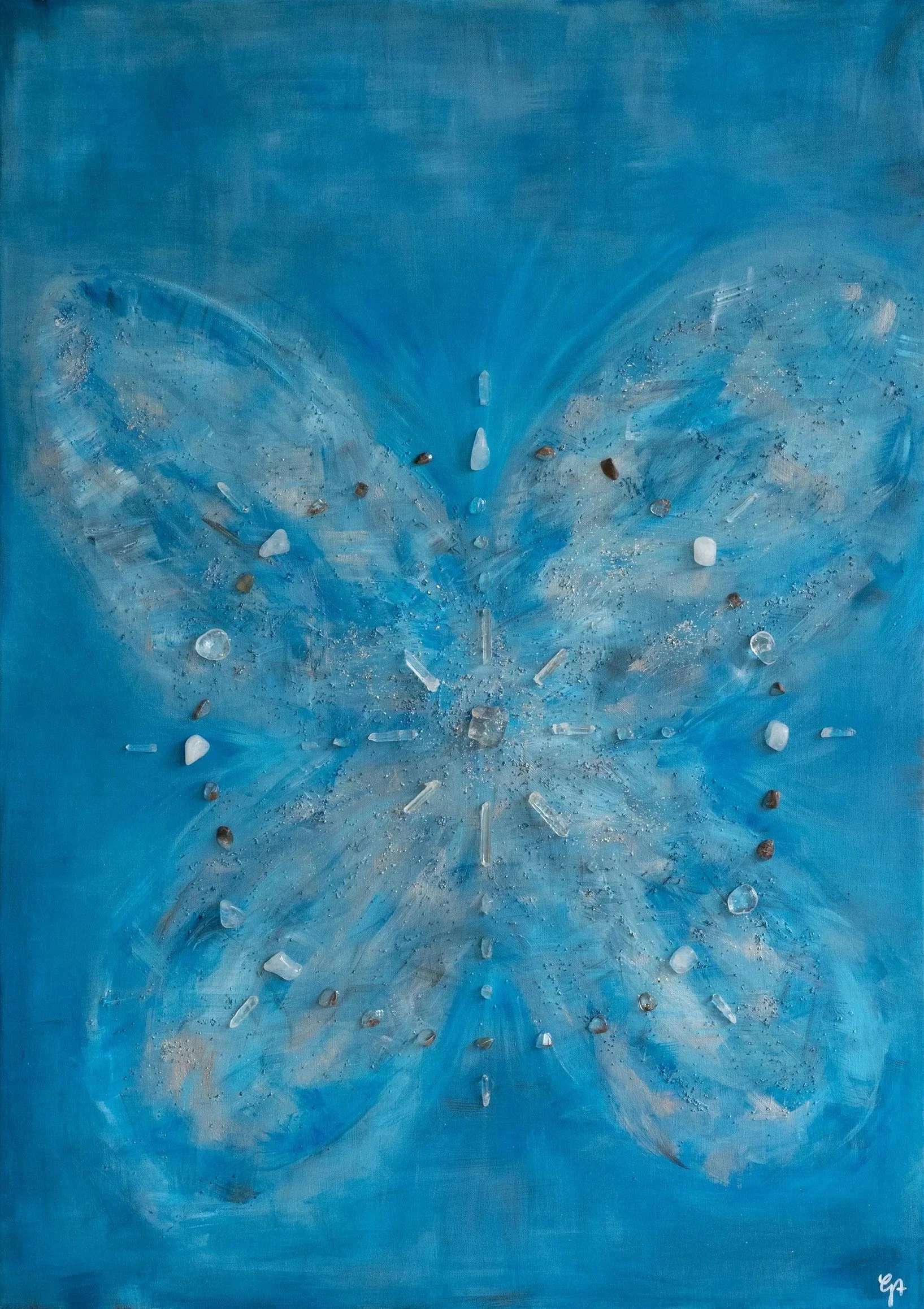
tengri by Geneva Arystan
Geneva: I think I’ve always had a personal connection to crystals through my grandfather, as well as a general affinity for gems. I find that I am constantly learning more about their properties and uses; I recently gained my Reiki certification, which has been a significant step forward in my research.
I initially took an IB Art course in high school, then went on to study for my BA at Central Saint Martins. During university, I also took a life drawing summer intensive at the École des Beaux-Arts in Paris, which helped me fine-tune those skills. Later, I did my master’s at Otis College in California and, upon graduating, got a job teaching an English Language and Composition course to freshmen at the Fashion Institute of Design and Merchandising in Los Angeles. All of these experiences, being in art school environments across different contexts, contributed to my understanding of both others and myself, as I was always in direct dialogue with so many amazing artists.
Addy: So many different experiences! Your time in California sounds like such an anchor for your practice. Given your literary background, how important are the titles of your works?
Geneva: I love naming my paintings! As a writer, I have an obsession with words, titles, and names. A lot of the time, a certain memory of mine will evoke inspiration for both a poem and an artwork. It’s fun to find a container or vessel for the memory. I recently finished a piece called ‘opal altar big sur’, which is inspired by a transformative spiritual experience I had hiking around Northern California last May.
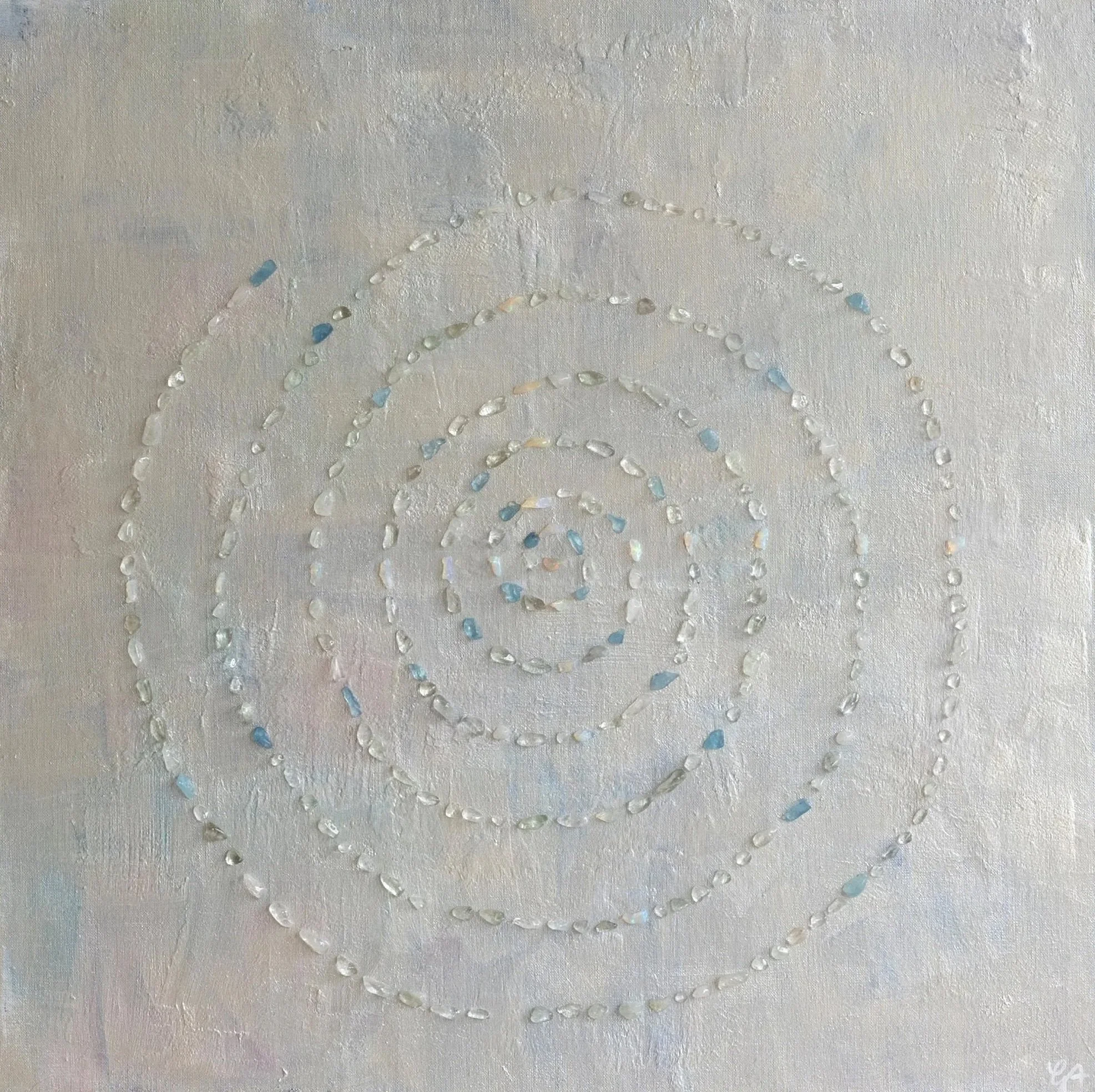
opal altar big sur by Geneva Arystan
Addy: Beautiful. Beyond the studio, where do you find inspiration?
Geneva: I think different places unlock new dimensions or layers of consciousness. I’ve always been drawn to the natural world, which is what originally pulled me to California. The ocean, the hills, the mountains, the hidden waterfalls, the desert… it all felt foreign, yet strangely familiar.
That feeling echoes my connection to Kazakhstan, where I grew up surrounded by mountains, lakes, and forests. There’s a similar sense of vastness and presence in both landscapes, something both ancient and alive. Moving between these worlds is something I am trying to translate into my work. Experiencing the world around me and exploring new ecosystems will always be the greatest driver behind my vision; I think if I were to pursue a career outside of the arts, I would definitely study ecology.
I recently travelled to Mexico, and I’m always curious to see each culture’s history and relationship with myth and magic, especially finding local artists who have a through-line to spirit and nature (which, in my eyes, are one and the same). I was able to visit Javier Senosiain’s Nido de Quetzalcóatl (Quetzalcoatl’s Nest) in person. I’ve admired his work for years, so to be able to see it and experience his style of ‘organic architecture’ and how he works with the earth, not against it, was incredibly beautiful.
Addy: Amazing. I’m obsessed with Javier Senosiain’s style of architecture and how he’s able to incorporate the landscape. Okay, so at the end of interviews, I like to do something called a rapid fire round 🔥 Here we go! Symbolism or Surrealism?
Geneva: Symbolism!
Addy: Hilma af Klint or Wassily Kandinsky?
Geneva: Hilma.
Addy: Oceans or deserts?
Geneva: Oceans.
Addy: Candlelight or moonlight?
Geneva: Moonlight.
Addy: Yes <3 Copper or silver?
Geneva: Silver.
Addy: Amethyst or Rose quartz?
Geneva: Clear quartz.
Addy: Love. Saltwater or sage?
Geneva: Sage, or Adraspan actually.
Addy: Interesting! Intuition or ritual?
Geneva: Intuition.
Addy: Spoken word or written poetry?
Geneva: Both!
Addy: The last song you listened to?
Geneva: Sweet by Brockhampton.
Addy: So nostalgic. Geneva, thank you so much!
For more from Geneva, check out her website here!
From the Archive

A conversation with emerging sculptor Hannah Lim 🗿